You are sitting 200 miles offshore. The marina is three days behind you, the next port is three days ahead, and your water tank is reading lower than you would like.
If you have a boat watermaker, that is not a problem. You fire up the system, and within minutes, the ocean around you becomes the most reliable water source you have ever had.
If you do not have one, you start rationing.
That gap, between freedom and anxiety, is exactly what a boat watermaker solves. But before you invest in a system, it helps to understand how one actually works. Not the marketing version. The real version: what happens inside the unit, step by step, from the moment saltwater enters the intake to the moment clean drinking water flows out of your tap.
This post walks you through the full process, covers what powers different systems, explains how much water you can realistically produce, and explains why the design choices behind your watermaker matter more than most buyers realise.
What Is a Boat Watermaker?
A boat watermaker is a reverse osmosis desalination system designed to produce fresh drinking water from seawater or brackish water while aboard a vessel. It is not a filter in the traditional sense. It does not just remove particles or chemicals from water that is already mostly fresh. It separates salt from seawater at a molecular level, producing water that meets drinking standards from a source that would otherwise be completely undrinkable.
The term “watermaker” is used almost exclusively in the marine world. On land, the same technology is called a reverse osmosis system or desalination unit. The core science is identical.
The Short Answer: Reverse Osmosis at Sea
Reverse osmosis works by forcing pressurised water through a semi-permeable membrane. The membrane allows water molecules to pass through while blocking dissolved salts, minerals, and contaminants. What comes out on one side is fresh water. What gets left behind is a concentrated brine stream that exits overboard.
The word “reverse” refers to the direction water moves. In normal osmosis, water moves naturally from a low-concentration solution to a high-concentration one. Reverse osmosis pushes it the other way by applying pressure, forcing fresh water out of the salty side.
How It Differs From a Regular Water Filter
A standard filter removes particles, sediment, or some chemicals. It cannot remove dissolved salts. Seawater contains roughly 35,000 parts per million (ppm) of dissolved solids, according to NOAA ocean salinity data. Safe drinking water sits below 500 ppm per WHO guidelines. A filter alone cannot bridge that gap. Reverse osmosis can.
How a Boat Watermaker Turns Seawater Into Drinking Water
The process runs in four main stages. Each stage matters. Skip or underperform any one of them, and the output quality or the lifespan of your system will suffer.
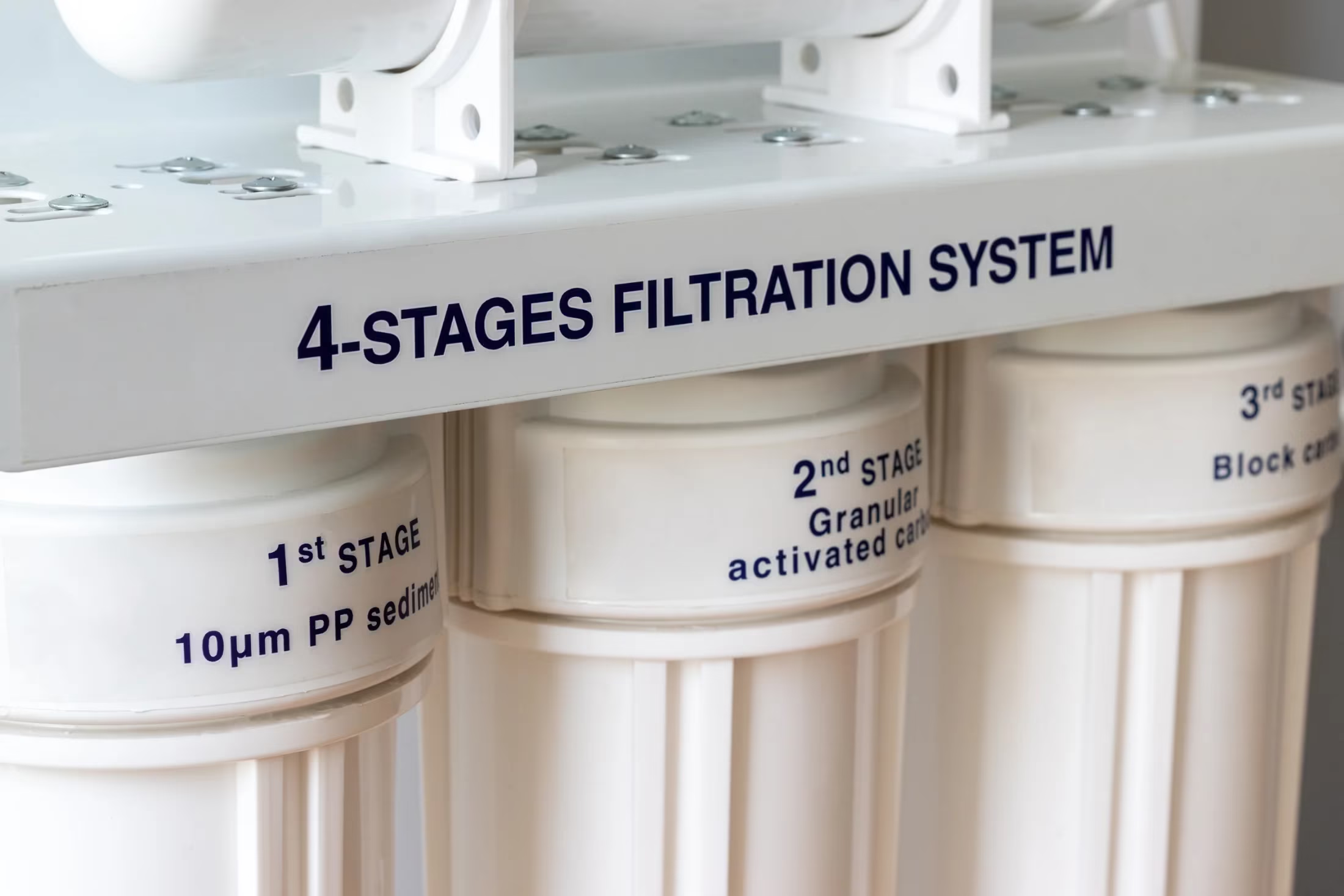
Step 1: Pre-Filtration — Removing Sediment and Debris
Before seawater reaches the high-pressure pump or the membrane, it passes through one or more pre-filters. These are typically sediment filters rated at 5 to 20 microns, sometimes with an additional carbon filter depending on the application.
Pre-filtration does two things. It protects the pump from abrasive particles that would accelerate wear. And it protects the RO membrane from fouling, which would shorten its lifespan significantly. This stage is low-drama but critical. Neglect your pre-filters, and you will pay for it downstream.
Step 2: High-Pressure Pumping — The Heart of the System
This is where the real work happens. A high-pressure pump takes the pre-filtered seawater and pressurises it to between 800 and 1,200 psi, depending on the salinity and temperature of the water. That pressure is what forces water molecules through the RO membrane.
The pump is also where most watermaker failures originate. Systems that rely on complex electronics, variable frequency drives, or energy recovery circuits introduce more potential failure points. ECHOTec’s systems use ceramic plunger pumps precisely because they are field-proven, serviceable in remote locations, and built to operate without the fragile electronics that cause problems at sea.
Step 3: The RO Membrane — Where Salt Gets Separated
The RO membrane is the core component of any desalination system for boats. It is a tightly wound semi-permeable film, typically spiral-wound, that allows water molecules to pass through while rejecting up to 99% of dissolved salts, heavy metals, bacteria, and most contaminants.
The pressurised seawater enters the membrane housing. Fresh water, called permeate, passes through the membrane and is collected for use. The remaining concentrated brine, called reject water or concentrate, exits through a separate line and is discharged overboard.
Membrane performance depends on water temperature, salinity, feed pressure, and how well the system is maintained. In warmer, lower-salinity waters, output increases. In colder or highly saline conditions, output drops slightly.
Step 4: Post-Filtration and Remineralisation
The water that comes through the RO membrane is very pure, often with a TDS reading under 50 ppm. Most systems pass this through a final carbon post-filter to improve taste. Some installations include a remineralisation cartridge to add trace minerals back in, which can improve palatability and bring pH to a more neutral level.
At this point, the water is tested-safe for drinking and meets WHO drinking water quality guidelines for TDS levels. Output goes directly to your tank or tap.
What Powers a Boat Watermaker?
The power source for your watermaker shapes everything else about it: where it can be installed, how much it costs to run, and how it fits into your vessel’s existing electrical setup.
AC vs. DC Systems
AC-powered watermakers run on 110V or 230V shore power or generator power. They are typically found on larger vessels with sufficient generator capacity or at installations with reliable shore access. AC systems tend to offer higher output at lower cost per gallon.
DC-powered systems run on 12V, 24V or 48V battery banks and are the standard choice for sailboats and smaller vessels that run on solar or wind charging. They draw more current per litre produced than AC systems but work within the constraints of a typical marine electrical setup. For most cruising sailors, a DC unit is the practical choice.
You can explore ECHOTec’s full range of watermaker types to compare AC and DC options across different vessel sizes and applications.
Belt-Driven Options
Belt-driven watermakers connect directly to the vessel’s main engine via a belt and pulley system, using the mechanical energy of the engine rather than electricity to drive the high-pressure pump. These systems can produce large volumes of water efficiently when the engine is running regardless of what state the battery bank is in. They are a strong choice for motor vessels and catamarans that run their engines regularly.
How Much Fresh Water Can a Boat Watermaker Produce?
Output is measured in gallons per day (GPD) or litres per day (LPD) and varies significantly by system type.
Output Ranges by System Type
A compact DC unit suited to a small cruising sailboat typically produces 15 to 30 GPD. Mid-range systems for 40 to 55 foot sailboats or motor yachts commonly output 30 to 80 GPD. Larger AC systems and industrial units can produce hundreds or thousands of gallons per day.
ECHOTec’s range extends from small DC units up to commercial-scale land-based systems producing up to 14,000 GPD.
How to Size the Right System for Your Vessel
The general guideline is to calculate your daily water use per person, typically 1 to 3 gallons per day for drinking and cooking alone, or 5 to 10 gallons per person when accounting for washing. Then match your system output to that demand, with enough headroom to make up shortfalls on good production days.
A sailboat watermaker rated at 30 GPD will keep a couple comfortable offshore without any rationing. A larger family or charter vessel needs to plan accordingly.
Is Watermaker Output Safe to Drink?
Yes, when the system is functioning correctly and maintained properly, the output from a reverse osmosis boat watermaker is safe to drink and typically purer than most tap water.
Quality Standards and What to Look For
The WHO recommends a maximum TDS of 500 ppm for drinking water. Most well-functioning RO membranes produce output in the 30 to 150 ppm range, well inside that threshold. Some boaters use a handheld TDS meter to verify output quality periodically, which is a sensible habit.
ECHOTec systems are built to meet NEMA, ASTM, API, NSF, and BSI standards, providing independent verification of build quality and materials. NSF certification in particular covers the safety of components that come into contact with drinking water.
You should test output TDS at commissioning and after any membrane change. A sudden rise in TDS reading is your early warning that the membrane needs attention.
What Maintenance Does a Boat Watermaker Need?
Relative to their value, boat watermakers require minimal maintenance. But minimal does not mean none.
Routine Care
- Replace pre-filters on schedule, typically every 100 to 500 operating hours depending on water quality
- Flush the membrane with fresh water after each use if the system will sit idle for more than a few days
- Check all fittings, connections, and hose clamps periodically for corrosion or weeping
- Monitor output TDS to catch membrane degradation early
Pickling for Storage
If the vessel will be laid up for more than two to four weeks, the membrane should be pickled with a sodium metabisulphite solution to prevent biological growth inside the membrane housing. This is a straightforward process and one of the most important things you can do to extend membrane life.
Our team covers installation and setup as well as watermaker repair and servicing for customers who want hands-on support with maintenance procedures.
Why Reliability Matters More Than Features
A watermaker with three extra features and one preventable failure point is a worse watermaker than a simple system that runs every time you turn it on. This is especially true offshore.
What Fails in Complex Systems
Energy recovery devices, variable frequency drives, and multi-stage electronic controls all add complexity to reduce energy draw. In a shoreside installation or a controlled environment, that tradeoff can make sense. In a marine environment, with constant vibration, salt air, humidity, and limited access to parts, complexity is the enemy.
The most common failure points in competitor systems are the electronics: control boards, sensors, and proprietary components that require a specialist or a factory part to fix. When you are three days from port, neither of those is available.
The ECHOTec Design Philosophy
ECHOTec builds around simplicity and field serviceability. Ceramic plunger pumps. High-quality, corrosion-resistant materials. Standard parts that can be sourced globally. Systems designed so that the person who owns them can also service them, without needing a technician on call.
That is not a limitation of the design. It is the design. Over 40 million collective operating hours across the AML/S series tells you what that philosophy produces in the real world.
The Bottom Line
A boat watermaker works by forcing pressurised seawater through an RO membrane that strips out dissolved salts, producing safe, clean drinking water from the ocean around you. Pre-filtration protects the pump and membrane. High-pressure pumping drives the process. The membrane does the separation. Post-filtration cleans up the output.
What makes a watermaker worth owning is not just the technology. It is the reliability of the system behind it, the quality of the components, and the confidence that it will run when you need it most.
Ready to find the right system for your vessel? Talk to our team at echotecwatermakers.com or request a quote today.
Frequently Asked Questions
How does a boat watermaker produce fresh water from seawater?
A boat watermaker uses reverse osmosis to separate salt from seawater. High-pressure water is forced through a semi-permeable membrane that allows water molecules to pass through while blocking dissolved salts and contaminants. The fresh water that comes through is collected for drinking and tank storage, while the concentrated brine is discharged overboard.
How much water can a marine watermaker produce per day?
Output depends on system size and type. Compact DC watermakers suited to smaller sailboats typically produce 15 to 30 gallons per day. Larger AC-powered or belt-driven systems for bigger vessels can produce 80 GPD or more. Industrial and land-based desalination systems can produce thousands of gallons per day.
Is the water from a boat watermaker safe to drink?
Yes. A properly functioning reverse osmosis system produces water with TDS levels well below the WHO drinking water guideline of 500 ppm. Most marine watermakers produce output in the 30 to 150 ppm range. Monitoring output TDS with a simple meter is the most reliable way to confirm your system is performing correctly.
How often does a boat watermaker need maintenance?
Routine maintenance includes replacing pre-filters every 100 to 500 operating hours, flushing the membrane with fresh water after use, and pickling the membrane during extended storage periods. Regular TDS monitoring helps catch any membrane degradation early. Compared to most marine systems, watermakers require relatively little upkeep when basic routines are followed.
What is the difference between an AC and DC boat watermaker?
AC watermakers run on 110V or 230V power from a generator or shore supply and suit larger vessels with generator capacity. DC watermakers run on 12V or 24V battery banks and are the standard choice for sailboats and smaller cruising vessels that rely on solar or wind charging. The right choice depends on your vessel’s power setup and typical operating conditions.
Can a boat watermaker be installed on any vessel?
Most vessels with adequate space for the pump, filters, and membrane housing can accommodate a watermaker. System sizing and power source selection vary by vessel type. Compact DC units suit smaller sailboats, while larger yachts and motor vessels typically benefit from higher-output AC or belt-driven systems. An ECHOTec watermaker specialist can advise on the best fit for your specific setup.