The combination of clean solar energy and reverse osmosis desalination represents one of the most practical examples of off-grid independence available today. Whether you are preparing for a bluewater passage with no marina stops for weeks, or building a remote coastal property that will never connect to municipal water, a solar-powered watermaker gives you access to unlimited drinking water from the sea or brackish sources with zero fuel cost and minimal environmental impact.
ECHOTec Watermakers has supplied solar-powered desalination systems to offshore sailors, island resorts, remote fishing operations, and off-grid homesteaders across the Caribbean, Pacific, and Indian Ocean regions. This guide covers the real-world considerations for designing and operating a solar watermaker setup that delivers reliable fresh water day after day.
The Case for Solar-Powered Watermaking
Traditional watermaker installations on boats and off-grid properties depend on engine runtime or shore power for operation. Engine-driven systems require fuel and contribute to engine wear. Shore-powered systems create dependency on grid infrastructure that may be unreliable or unavailable in remote locations. Solar-powered watermakers eliminate both limitations.
A well-designed solar watermaker setup operates silently, produces no emissions, and generates fresh water at zero marginal cost after initial installation. For sailors, this means less engine runtime and more fuel available for entering difficult harbors under power. For remote properties, it means true independence from fuel deliveries and grid connections. ECHOTec’s solar-compatible DC watermaker range makes this level of independence achievable at a realistic cost.
Key Components of a Solar Watermaker Setup
A complete solar watermaker installation involves several interconnected systems. Understanding how they work together is essential for reliable performance.
Solar Panels
Monocrystalline solar panels deliver the highest efficiency per square meter of surface area, which matters on a boat deck or compact land installation where space is limited. Rigid panels mounted flat on a deck or angled on a roof produce the most energy per unit of surface area. Flexible panels can conform to curved surfaces and reduce windage on sailing vessels, though typically at some cost to efficiency and longevity.
For a solar watermaker setup intended to cover both daily water production and general electrical loads, a total panel array of 400W to 800W is a reasonable starting range for a two-person cruising boat or small off-grid dwelling. Larger households or higher water demand situations require proportionally more panel capacity.
MPPT Solar Charge Controller
Maximum power point tracking controllers are essential in any serious solar installation. MPPT technology continuously adjusts the electrical operating point of the panels to extract maximum available power under varying light conditions. In partially cloudy conditions, an MPPT controller recovers substantially more energy than older pulse width modulation (PWM) designs. Size the controller to handle your full panel array capacity with appropriate headroom for future expansion.
Battery Bank
The battery bank stores solar energy for use during low-light periods and overnight. For a solar watermaker setup, lithium iron phosphate (LiFePO4) batteries offer the best combination of usable capacity, weight, and cycle life. Lithium batteries tolerate partial state-of-charge operation better than lead-acid alternatives, which suits the variable charging profile typical of solar systems. A 200Ah to 400Ah lithium bank provides practical operating flexibility for most cruising or off-grid scenarios.
ECHOTec DC Watermaker
ECHOTec’s DC watermaker range is engineered from the ground up for solar-compatible, battery-bank-powered operation. Available in 12V, 24V, 36V, and 48V configurations, ECHOTec DC units can be matched to any common off-grid electrical system architecture. The ceramic plunger pump technology used across the ECHOTec range delivers exceptional longevity in seawater applications with minimal maintenance requirements.
Pre-Filtration System
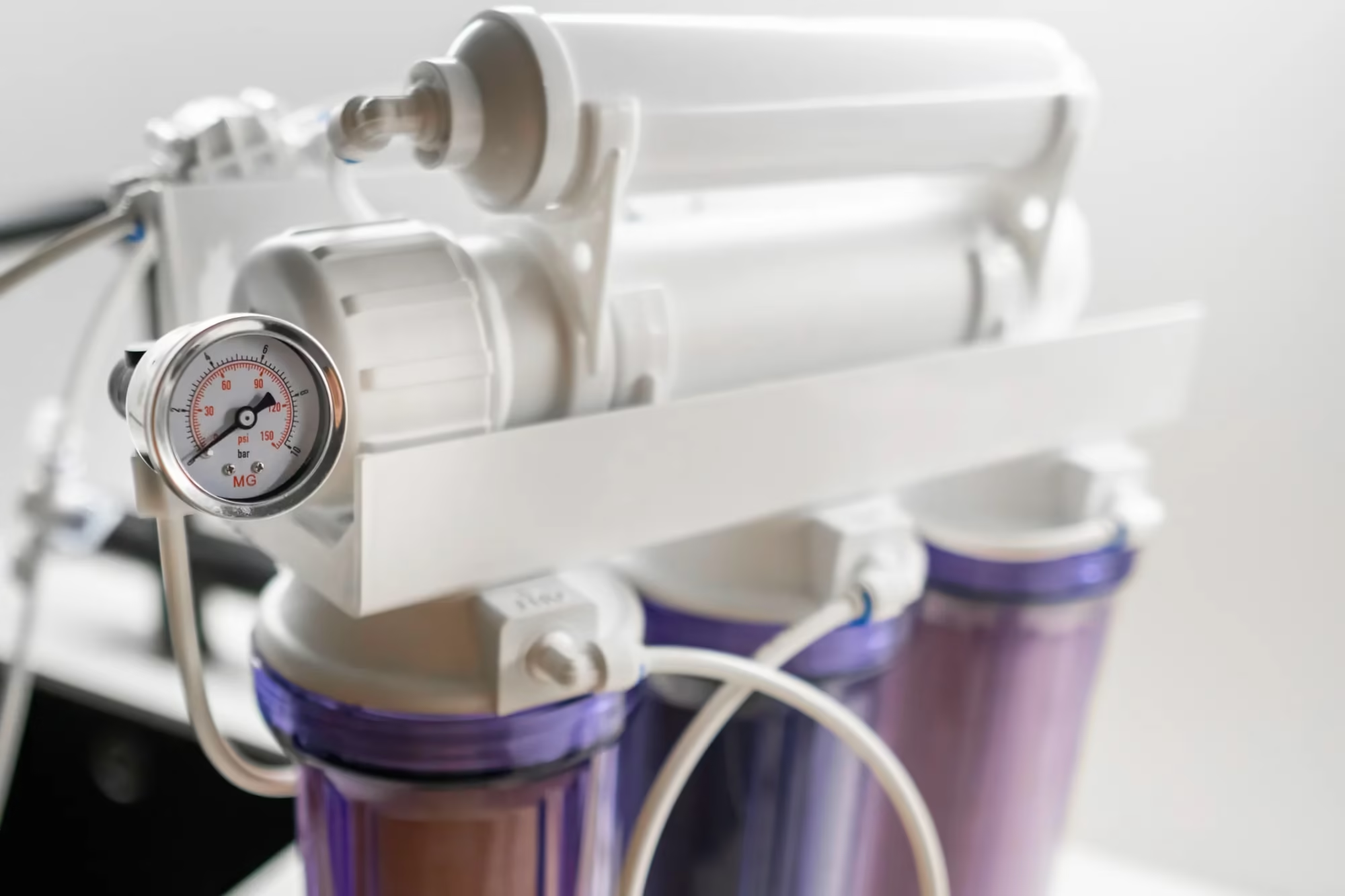
Solar-powered watermaker systems should include the same pre-filtration standard as any marine desalination installation: a sediment pre-filter to remove particulates down to 5 to 20 microns, followed by an activated carbon block filter to address biological material and chemical contaminants. Clean pre-filters protect the high-pressure pump and RO membrane, preserving production output and water quality.
Designing for Your Specific Environment
Solar watermaker performance varies significantly based on where and how you operate. Designing the system for your actual environment rather than ideal conditions leads to much better real-world outcomes.
High-Latitude Operations
Sailors cruising at higher latitudes experience significant seasonal variation in solar production. A system sized for a Pacific summer may be significantly underpowered during a Scottish or Alaskan summer, where sun angles are lower, and cloud cover is more persistent. For high-latitude applications, a supplemental charging source such as a wind generator or towed generator provides important backup capacity.
Tropical and Equatorial Operations
Tropical environments offer excellent solar production but introduce additional challenges for watermaker membranes. Warmer seawater temperatures reduce the pressure required for desalination but increase biological fouling rates on membrane surfaces. Frequent flush cycles and more regular membrane cleaning intervals are standard practice in tropical operations.
Remote Land-Based Installations
Off-grid coastal properties present different design priorities than marine installations. Panel mounting structures need to withstand local wind loads. Battery banks may need temperature management in extreme climates. Water production needs to scale with household or community demand rather than the smaller volumes typical of sailboat living. ECHOTec’s land-based desalination systems, detailed on the home and land-based desalination page, cover a wide range of production capacities suited to remote property applications.
Operating a Solar Watermaker for Best Results
Scheduling Production
Run the watermaker during peak solar hours when the panels are generating at maximum capacity, and the battery bank is at a high state of charge. This approach minimizes net battery draw and keeps the pump operating at full performance with stable supply voltage.
Monitoring Water Quality
A simple inline TDS (total dissolved solids) meter provides a continuous check on membrane performance. RO membrane rejection rates degrade gradually over time and can drop sharply following an event such as a chlorine slug in the feedwater or oil contamination. Monitoring TDS gives you early warning before water quality becomes a health concern.
Long-Term Storage Procedures
If the solar watermaker will not be operated for two weeks or more, the membrane should be chemically preserved to prevent biological growth. ECHOTec provides guidance on proper storage and preservation procedures through the ECHOTec technical support and refurbishment resources, ensuring you return from a break to a fully functional system.
Real-World Solar Watermaker Performance
ECHOTec DC watermaker customers operating on solar report production running costs that effectively drop to zero after the initial investment in the solar array and battery bank. For cruising sailors who previously budgeted for marina water purchases or fuel for generator operation, the payback period on a properly sized solar watermaker setup is often measured in one to two sailing seasons.
For remote property owners, the independence from water delivery costs, water tanker logistics, and the environmental burden of plastic bottle consumption represents a genuine improvement in both economics and quality of life.
Frequently Asked Questions
How much solar power do I need to run a watermaker?
The required solar capacity depends on your watermaker’s power draw, your daily water production target, and all other electrical loads on the system. A compact ECHOTec DC unit drawing 10 amps for two hours per day requires 240 watt-hours for water production alone. A 400W solar array in a region with four to five peak sun hours per day produces 1,600 watt-hours, providing a substantial margin above the watermaker’s needs while covering other onboard loads.
Can a solar watermaker work on cloudy days?
Yes, with appropriate battery bank sizing. Solar panels continue to generate power on overcast days, typically at 10 to 25 percent of their rated capacity. A well-sized battery bank absorbs this variability and allows watermaker operation to continue without interruption during periods of reduced solar production. Scheduling production during the brightest part of the day maximizes the benefit of available light on overcast days.
What maintenance does a solar-powered watermaker need?
A solar watermaker system requires maintenance at multiple levels. The watermaker itself needs periodic pre-filter replacement, membrane flushing after each use, annual pump inspection, and occasional membrane cleaning. The solar components require panel cleaning to maintain efficiency, charge controller inspection, and battery bank monitoring. The ECHOTec watermaker components are designed to be serviceable by the owner with standard tools and readily available parts.
Is a solar watermaker practical for full-time liveaboards?
Absolutely. Many ECHOTec customers are full-time liveaboards who depend on their solar watermaker as their primary source of fresh water. The key to making it work full-time is generous solar panel and battery bank sizing, a disciplined maintenance schedule, and carrying adequate spare parts, including pre-filter cartridges, a spare drive belt where applicable, and replacement pump seals. ECHOTec’s worldwide parts support network ensures spares are accessible in most major sailing destinations.