Marine Watermaker Maintenance: Weekly, Monthly, Annual
Most marine watermaker failures are calendar failures, not engineering failures. The pump did not wear out. The membrane did not reach the end of its life. Something did not get done on time, and the consequences arrived three months later as reduced output, rising salinity, or a membrane that no longer responds to cleaning.
The good news is that the list of things that actually kill these systems is short, and the intervals are predictable. This guide sets out a working marine watermaker maintenance schedule organised by interval: what to do every run, what to do weekly, what to do monthly, and what belongs on an annual service. It also covers what changes when the system sits idle, which is where a large share of avoidable damage happens.
What this guide covers:
- Why intervals matter more than effort
- Every-run habits that take two minutes
- Weekly checks
- Monthly checks
- Annual service
- What to do when the system sits unused
- How to tell whether your maintenance is working
Why Marine Watermaker Maintenance Is About Intervals, Not Effort
A reverse osmosis system is mechanically simple and operationally unforgiving. Seawater passes through an intake, a strainer, pre-filters, a high-pressure pump, and a membrane. Every one of those stages is exposed to salt, silt, biological growth, heat, and vibration. Maintenance is not about dismantling the unit regularly. It is about controlling the handful of conditions that shorten component life.
What kills systems early
Four things account for most premature failures.
- Biological growth in standing water when the system is idle
- Silt and organic matter reaching the membrane because pre-filters were left too long
- Salt left in the system after shutdown, driving corrosion and scaling
- Chlorine contact with the membrane, which causes irreversible damage
None of these require expensive intervention to prevent. All of them are expensive to fix.
Your operating environment changes the schedule
Intervals are guidelines, not laws. A system running in clean offshore water will need pre-filter attention far less often than one operating in a silty estuary, a busy anchorage, or warm tropical water after heavy rainfall. Plankton blooms and river runoff can clog a pre-filter in hours.
Adjust upward when the water is dirty. The gauges will tell you when you are behind schedule before the membrane does.
Every Run: The Two Minute Habits
These are not really maintenance tasks. They are operating discipline, and they catch more problems than any scheduled service.
Pressure and flow readings as an early warning system
Note feed pressure, operating pressure, and product flow at the start and end of every run, and write them down. A single reading tells you almost nothing. A trend tells you everything.
- Feed pressure falling: pre-filter clogging or intake restriction
- Operating pressure rising at the same output: membrane fouling or scaling
- Product flow falling at normal pressure: membrane fouling, or a temperature effect if the water is colder than usual
- Product quality drifting upward: membrane degradation or a seal issue
A TDS check every time you start up
Check product water TDS each time you start the system. Any standard TDS meter with a 0 to 999 ppm scale will do the job. When you are running at a dock or near a more industrial area, check more often during operation, and do the same whenever the water quality or your surroundings change. The aim is to catch a change in water quality before product water goes to your tank.
Record every reading alongside your pressures and flow. Salinity creeping upward is the earliest reliable indicator of membrane trouble, and it appears long before the water tastes wrong.
The freshwater flush, and why chlorine ruins it
Flush the system with fresh water after every shutdown. This removes seawater from the membrane and pressure vessel, which slows biological growth and reduces corrosion and scaling throughout the system. The flush does not need high pressure. Regular boat water pressure is enough, or the boost pump can supply the flow.
One rule matters more than any other here. The flush water must be chlorine-free. Reporting on watermaker upkeep in Southern Boating notes the same point that membrane manufacturers make: chlorine can rapidly damage an RO membrane, so product water from the system itself is the best flush source, and tank water must be confirmed chlorine-free before use.
Weekly Marine Watermaker Checks
If you are cruising and using the system regularly, these are the weekly items.
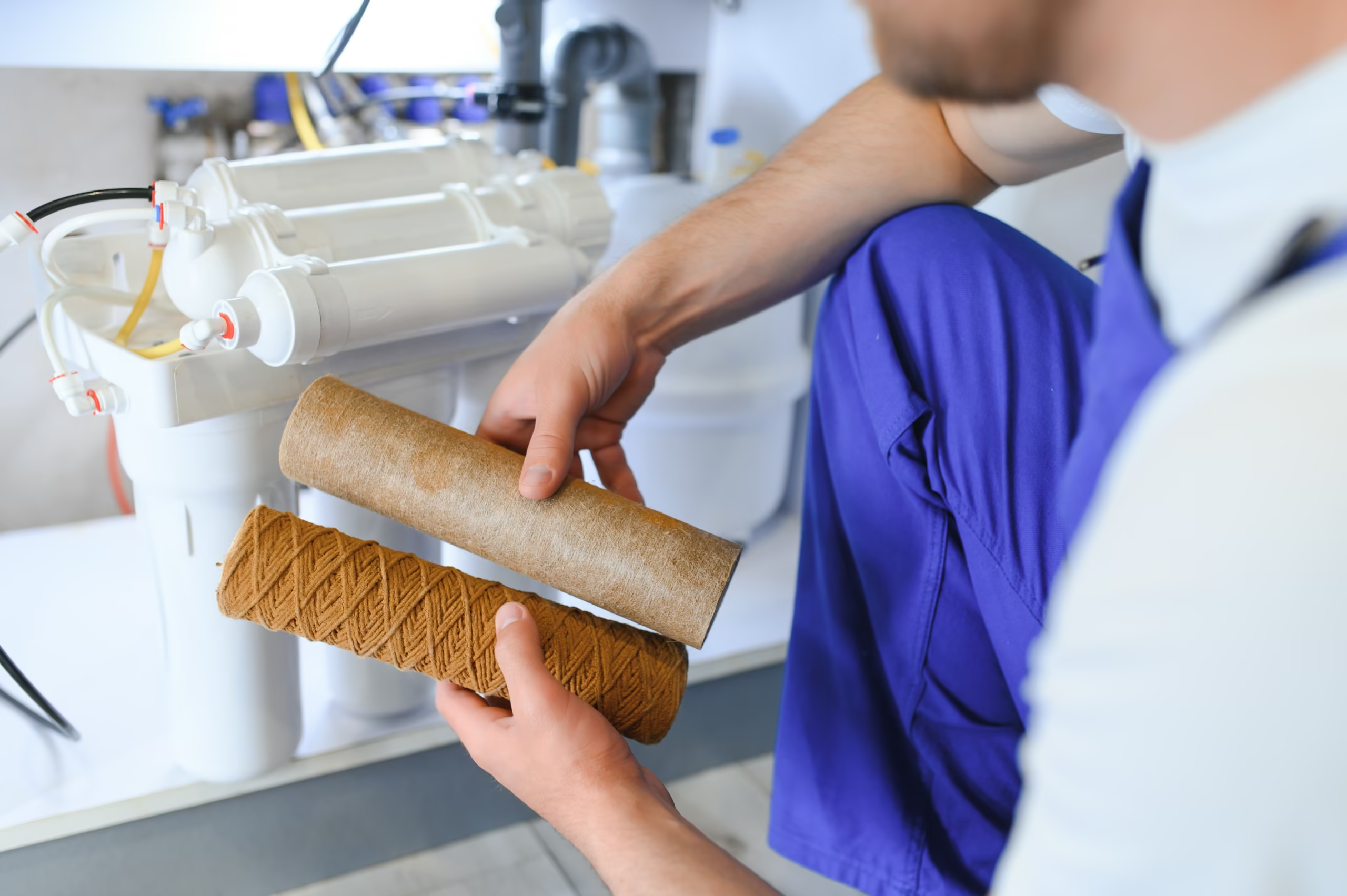
Pre-filter inspection, cleaning and swapping
Look at the filter housings. In clear water, you may go weeks. In silty or plankton-rich conditions, you may be cleaning them every few days. Do not judge by the calendar alone. Judge by the pressure drop and by what you can see in the housing. A partially clogged filter that looks acceptable is still forcing the pump to work against a restriction.
ECHOTec’s pleated pre-filters are cleanable and designed to be reused. Wash and gently scrub them in fresh water with a drop of chlorine, then rinse and scrub again with fresh water only, and hang them in the sun so UV light finishes the cleaning and dries them. Rinse thoroughly before refitting, since chlorine must never reach the membrane. With a second set aboard, you can swap them over each time and keep using the same elements for a long time.
One-time-use cartridges are best kept as a last resort. Besides being bad for the environment, they restrict flow more than a clean pleated element, and that cuts water production.
Freshwater flushes when the system is not running
If the system is not being run, flush it with chlorine-free fresh water every 3 to 5 days for a couple of minutes, or preserve it. Systems that sit idle while the boat is in use are more likely to develop biological growth than systems that run daily. Our older guidance on what maintenance a boat watermaker really needs covers this habit in more detail.
Monthly Checks
Monthly work is inspection rather than intervention. You are looking for the things that fail quietly.
Hoses, clamps, fittings and mounts
Work through the installation with a torch. Check every hose for chafe, hardening, and cracking, particularly where hoses pass through bulkheads or run near vibrating components. Check clamps for corrosion. Check that mounting brackets are still tight, because vibration loosens fasteners over a season, and a system that has started to move will stress its own plumbing.
Practical Sailor’s annual inspection guidance for boats applies the same logic to through-hulls, hoses, and clamps across the vessel, and the watermaker’s raw water circuit deserves the same treatment.
Pump service points and belt condition
Check oil level and condition where your model uses an oil-lubricated pump. Look for weeping at seals and valves. A saltwater or oil leak only gets worse over time, so address it as soon as you find it rather than running through the season with it. On belt-driven installations, check belt tension and look for glazing, cracking, or dust, which indicates misalignment or slip. Our overview of belt-driven systems covers what normal wear looks like on these installations.
Annual Service
Once a year, the system gets attention it does not get during normal operation.
Membrane cleaning against membrane replacement
ECHOTec specifies two cleaning compounds, used in order. Compound #1 is a bio clean that removes organics that have settled on the membrane, and it can be used many times. Compound #2 is an acid clean, an anti-scalant that removes older mineral build-up and grime.
Both run without pressure. For yacht systems, fill a jerrycan with the cleaning mixture, remove the pre-filters so the maximum amount of compound reaches the membrane, put both the intake and outlet hoses into the jerrycan, and circulate it for 15 minutes, looping it around the system a few times. The boost pump can do the circulating. Run compound #1 first, then compound #2.
Cleaning recovers performance lost to organic and biological fouling and to scale. It does not recover a membrane damaged by chlorine, oxidation, or drying out.
Clean when the trend data tells you to, not on a fixed date. Rising operating pressure at constant output, falling product flow, or salt rejection dropping consistently are the signals. Low output can also come from the feed supply, old valves, or a leaking pump, so rule those out first. If the rest of the system is in order and product TDS is below 500 ppm, but production is around 50 per cent of normal at a seawater temperature of about 23°C, a clean with #1 and #2 can bring the membrane back to near its original production. If cleaning does not restore performance, replacement is the answer, and that is a component swap rather than a system failure. Every ECHOTec replacement membrane ships with its endplug O-rings free of charge.
Seals, oil changes, and the parts to hold in inventory
Change the high-pressure pump oil after the first 50 hours of operation, then every 500 hours or once a season, whichever comes first. Seal life depends heavily on how the unit is used. Pumps are rated to last 1,500 hours, yet some owners run the same seals for 15 years. Clean pre-filters, clean oil, a stable feed water supply, and a smooth pressure build-up all help seals and valves last longer. Replace O-rings only when they are worn.
Build a spares inventory around what actually gets consumed: a second set of pleated pre-filters, O-rings and seals, a spare high-pressure hose, and the pump service kit for your unit. Our list of spares every boater should carry is a sensible starting point.
What Should You Do If the System Sits Unused?
Idle time is where most preventable damage happens, because nothing appears to be going wrong while it does.
There are two ways to protect an idle membrane, and either one keeps it in the same condition: a regular freshwater flush, or preservation. There is no limit to how many times a membrane can be preserved, and neither option needs high pressure. Regular boat water pressure or the boost pump will do, and if you use the boost pump to preserve, remove the pre-filters first.
| Situation | What the system needs |
| Someone aboard to flush | Freshwater flush with chlorine-free water every 3 to 5 days, for a couple of minutes |
| You would rather not keep flushing | Preservation with a biocide solution, as often as needed |
| Nobody aboard to flush | Preservation with a biocide solution |
| Extended layup or storage | Preservation plus periodic inspection of the solution |
Membrane manufacturers are explicit about preservation. DuPont’s handling, preservation, and storage guidance for FilmTec elements specifies a standard storage solution of 1 per cent food-grade sodium metabisulfite, with preserved elements visually inspected for biological growth and re-preserved if the solution stops running clear. DuPont
The practical version for a boat owner: if nobody will be aboard to flush every 3 to 5 days, pickle the system.
When you bring a preserved system back into use, dump at least the first 20 minutes of product water. A flush alone does not clear the storage compound out of the membrane; the unit has to be in high-pressure production for that.
How Do You Know Marine Watermaker Maintenance Is Actually Working?
Read the logbook rather than guessing
A maintenance log with pressures, flow, TDS, and dates turns vague impressions into evidence. It tells you whether output has genuinely dropped or whether the water is simply colder. It tells a service technician in five minutes what would otherwise take an hour of diagnosis.
Three symptoms that mean stop and diagnose
- Product water salinity rising steadily over several runs
- Operating pressure climbing while output falls
- Noise, vibration, or cavitation from the high-pressure pump
Any of these means investigate before running further. Continuing to run a system with a pressure or intake fault is how a maintenance item becomes a repair. If you are past the point where the trend data makes sense, our troubleshooting and refurbishment support team can work through it with you.
Conclusion
Marine watermaker maintenance is not demanding, but it is unforgiving of gaps. Check TDS every time you start up, flush after every run with chlorine-free water, watch the pressure and flow trend, clean pre-filters based on conditions rather than the calendar, inspect the installation monthly, change the pump oil on its hour-based schedule, and flush every 3 to 5 days or preserve whenever the system sits idle. Systems maintained that way can provide long-lasting service, and that is the experience behind our 40-plus million collective operating hours across the AML/S series and 5,000-plus units in service worldwide.
Not sure whether your current intervals are right for the water you operate in? Get in touch at sales@echotecwatermakers.com or visit echotecwatermakers.com to talk it through with our team.
Frequently Asked Questions
How often should you service a marine watermaker?
Check TDS at every start-up and flush after every run, inspect and clean pre-filters weekly during regular use, inspect hoses, fittings, and pump service points monthly, and carry out a full service annually. Change the pump oil after the first 50 hours of operation, then every 500 hours or once a season, whichever comes first.
How long do marine watermaker membranes last?
With correct flushing, timely pre-filter changes, and proper preservation during idle periods, membranes commonly last five years or more, and well-maintained examples run considerably longer. Chlorine exposure, drying out, and neglected biological growth are what cut that short.
Can I clean a marine watermaker membrane myself?
Yes. ECHOTec specifies compound #1 (bio clean) followed by compound #2 (acid clean), each circulated without pressure for about 15 minutes with the pre-filters removed. Cleaning restores performance lost to fouling and scale, but it cannot reverse chemical damage or a membrane that has dried out.
What watermaker parts should I keep on board?
A second set of pleated pre-filters, O-rings and seals, a spare high-pressure hose, and the pump service kit for your model. If you are cruising away from suppliers, add a spare membrane for long passages or extended time in remote areas.
Does a marine watermaker need maintenance if it is not being used?
Yes, and idle systems need more attention than working ones. Either flush with chlorine-free fresh water every 3 to 5 days for a couple of minutes, or preserve the system with a biocide solution. Both keep the membrane in the same condition. If nobody will be aboard to flush, preserve it; otherwise, biological growth develops inside the membrane.